Organization of the
Petroleum Exporting Countries (OPEC)
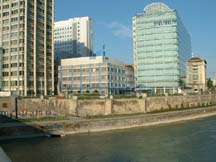
Sandwiched between a splashy IBM office building and offices
for a savings bank, the four-story OPEC building fronts the Danube
Canal. Founded in Geneva back in 1960, the Organization of the
Petroleum Exporting Countries (OPEC) has called Vienna home since
1965 and has been in its present location since 1977.
It's a little unnerving riding up to the entrance of OPEC because
there's a machinegun-toting Austrian soldier standing guard outside
the front doors. The soldier eyes me suspiciously as I ask if
it's okay to lock my bike outside the entrance. I get the okay.
I check in with the receptionist, who is either a chain smoker
or too lazy to empty the overflowing ashtray filled with cigarette
butts on the reception counter. There's a huge teak mural in
the lobby, which I estimate to be eight feet high and 16 feet
long.
I receive a warm welcome from Siham Alawami, Public Relations
Co-ordinator. Before heading up to her office we take a peek
in the ground floor library. This isn't just any old library
but according to Alawami, it's the world's largest library dedicated
to energy.
We go through my questions quickly. Why? A group of college students
from Kansas are visiting and in a few minutes a film will be
shown giving the history of OPEC. Actually, the film is quite
interesting. The founding members of OPEC are Iran, Iraq, Kuwait,
Saudi Arabia and Venezuela. Full members include Qatar, Indonesia,
Libya, United Arab Emirates, Algeria and Nigeria. Ecuador and
Gabon are former members. How do you become a member? The OPEC
Statue stipulates that "any country with a substantial net
export of crude petroleum, which has fundamentally similar interests
to those of Member Countries, may become a Full Member of the
Organization, if accepted by a majority of three-fourths of Full
Members, including the concurring votes of all Founders Members."
When the film is over questions are taken. The first, "Why
is OPEC headquartered in Vienna?" is according to Alawami
the most frequently asked question. The answer: diplomatic immunity
and tax benefits. What's the official language of OPEC? English.
About 130 employees work in the building built in the 1970's.
There's plenty of employee parking, no cafeteria, smoking in
offices is optional and there're no recreational facilities-though
they do have showers.
The boardroom? It's a big meeting room dominated by a large U-shaped
table. This is where the oil ministers meet and vote plus, it's
also used for press conferences.
|
