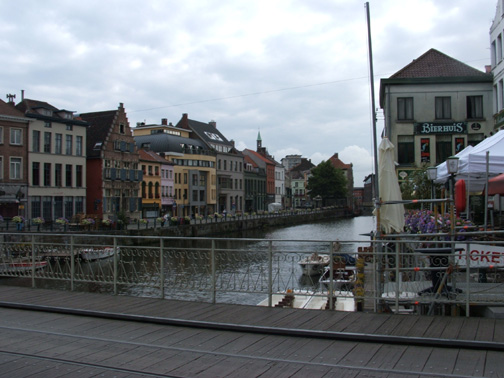
Stories From 1995 Trek Through Belgium
Here's a list
of the companies found by scrolling below: S.A. Delhaize "Le
Lion" Though furnishings in headquarters are spartan and definitely no-frills, I have a great visit due to Verleye and Tenaerts. My questions are answered sitting in the company's boardroom on the second floor of the two-story structure. How old is the building? Old enough not to have elevators. The 125-year old company has been on the site since 1892. Delhaize operates supermarkets in France, Czech Republic, Greece, Belgium and the United States. In the USA they operate the Food Lion and Cub Foods chains. With over 1,000 stores and sales for the first half of 1995 of US$3.8 billion, Food Lion is one of the biggest chains in America. I tell Verleye and Tenaerts about my visit several years ago to Food Lion's office in Salisbury, North Carolina. Though I was given a cordial welcome at Food Lion I kept getting the feeling something was amiss. Sure enough, the Sunday after my visit I found out: The television show "60 Minutes" ran a devastating story on Food Lion with hidden cameras documenting incidents such as meat cutters mislabeling, recycling and repackaging bad meat sold in stores when it should have been tossed. Stepping across the
hall from the boardroom puts me in CEO Gui de Vaucleroy's very
modest second floor corner office. It's definitely no-frills.
There's a plaque on a wall which reads: "The customer is
king". Ironically, hanging on another wall there's a framed
picture of a king, not just any king but, the King of Belgium
(now deceased) shopping in a Delhaize food store. So, what's
the view from Vaucleroy's office? It's situated right above the
sole road going in and out of the place which means he can keep
tabs on employees leaving early or getting in late. Displayed on the dock
outside the wine plant entrance there's a company bicycle used
in the 1920's for delivering customer's groceries plus, there's
also a fire engine from the late 1800's.
Solvay SA One of the two security guards is very helpful (the other says I have to have an appointment and isn't willing to call up to find out who my contact person is so I can make an appointment). I'm put on the phone to a woman assistant in public relations who says it isn't possible to track down my letter and I should mail in another letter explaining what I'm doing. Nuts to that as I leave some material behind and decide to come back in several days. I pick up a company employee magazine on the way out and note the article titled, "First Impressions Count" about Solvay winning the 1994 Belgian Telephone Trophy. It's awarded to the company whose staff had the best telephone manner when greeting callers over the phone. A portion of the story reads, "The initial contact with the company, the simple telephone call, must leave a positive impression with the customer, supplier or external partner. However, the corporate image also depends on promptness in replying, and as much thought and attention should go into greeting people by phone as goes into an advertisement or an annual report." Hmmph, thanks to the less-than-helpful response from the public relations woman my first impression of the company isn't very positive. Returning later in the week proves to be a smart move as I hook up with Paul Muys, External Relations Officer. I don't know if it's just a Belgium "thing" but, Muys's last name on his business card is in all capitals. Ditto for the fellows at Delhaize. Though he's been with the company only a few weeks, Muys does his best in answering questions. We're in a five-story building and across the street in a similar looking pre-War building are offices for Solvay Belgium. Approximately 500 work in the two. Solvay, with 1994
revenues of US$ 8.2 billion, is the world's 20th largest chemical
and pharmaceutical company. Solvay's the world's largest producer
of soda ash, digestive products and hydrogen peroxide. It's also
the world's second largest producer of salt and laxatives. Janssen's in a meeting in his second floor middle office but I sneak a peek as we walk by. Looks pretty normal but, his ugly green carpet as well as the visibly worn-out green carpet in the hallway has to go. SIDEBAR* Visiting
several other companies I learn my contact person, Paul Muys,
until he took this job with Solvay, was Belgium's leading television
newscaster. I didn't catch him reading off a cue card once. Electrabel and
Tractebel Tractebel's six-story headquarters is a good-looking neoclassical edifice. The marbled lobby area is filled with a walk-through display celebrating the company's 100th anniversary this year. The receptionist, more interested in her personal phone conversation, acts perturbed that I've interrupted her. Francois Desclee de
Maredsous, Company Secretary, turns out to be my contact person
and I'm directed upstairs via an elevator hidden behind a door.
Maredsous says King Leopold II of Belgium originally built this
building as a hotel in 1934. Back then and to this day visiting
the King's palace from here isn't much of a trek because the
backside of the palatial digs sit right across the street-less
than a Frisbee toss away. With the United States embassy down
one end of the street and the King's palatial palace practically
next door, this is quite the prestigious location. Tractebel's revenues in 1994 were US$9.1 billion, profit US$ 320 million. Besides Electrabel, Tractebel operates in other areas including engineering services (over 2,500 engineers), natural gas, communications and real estate. SIDENOTE*I always
ask companies if there's anything unusual about their headquarters
such as there being a helipad atop the building or it's situated
on a former cemetery site. When asked, Maredsous answered with
it being a former hotel built by a king. Well, it turns out the
place has more history to it than Maredsous let on. At least
a half-dozen other companies visited asked me if Tractebel mentioned
the fact that the German Gestapo had their headquarters in the
place from 1940 to 1945. Societe Generale
de Belgique S.A. So, if I were Belgium's king and was living in the King's Palace and was sitting out on the front porch rocking away in my rocking chair I'd see a large square across the street with a park in the middle. I'd also see various identical size, four-story Georgian-style buildings fronting three sides of the block long by block wide park. Why? Because more than 100 years ago an earlier Belgium king laid out the area and that's what he liked. I mention the above because my contact person Katryn Nassens, communications, says it explains why Societe Generale de Belgique tore down it's Georgian offices across the street from the King's palace in 1972 and rebuilt it in the same style: out of respect to the long gone king's wishes. Though the king's palace isn't open to the public, visiting Generale de Belgique's offices makes me think of palatial palaces. Once past the receptionist and security guard, two large antique traveling trunks greet you before entering a long, impressive marbled corridor. Four huge 17th century Belgium tapestries hang from the corridor walls and several glass displays contain company memorabilia, including a ledger and share of company stock, both dated 1822 (that's when Generale de Belgique was founded). Roughly 100 people work here and having a meeting in one of the conference rooms is quite an experience. Nassens answers questions sitting in a high-ceilinged meeting room called the King's Room. Jeez, if the fancy, formal furnishings don't make me feel underdressed, the large oil portraits hanging on the wall of past Belgium kings (King Leopold 1, 2, 3, 4 and 5) do. Wow!, walking into the first floor boardroom the words grand, sumptuous, power and history come to mind. The room is BIG and the boardroom table is looonnng. It seats 60. The wood floor complements the 18th century chandeliers and several more huge 17th or 18th century tapestries hang from a wall. Ivory plaques of executives from 1822-1961 are displayed. Definitely has the possibility of making my international listing of 10 Best Boardrooms. Can't see CEO Philippe
Liotier's office because "he's new and isn't here yet".
Oh no!, guess what Nassens reveals to me. Liotier replaces former
CEO Gerard Mestrallet, who's now CEO of Compagnie de Suez SA,
a French financial and industrial Goliath, which AHHHHHHHHHHHHHHH!!!!!!!
CONTROLS Societe Generale de Belgique. PetroFina SA The two friendly receptionists, looking real sharp in their matching blue blazer outfits, give my contact person Hans Daems, public relations and communications, a call. Normally, the receptionist hands you a visitors badge to wear but not here; you get to type up your own via the computer sitting atop the receptionist's counter top. Looking over Daems's business card I notice his last name in all capitals which is proving to be the rule rather than the exception. As I mentioned in my The Netherlands stories, the rule there was to only put the first initial of your first name and then your whole last name on your business card. Here, you put your first name and last name but, the last name gets all capitals. The seven-story building,
which fronts the public sidewalk, is actually comprised of several
buildings added on to over the years with the first built in
the 1950's and the last in the 1980's. On the backside there's
an enclosed courtyard garden. About 600 people work here. Looking into Managing Director's Francois Cornelis's office I note the fresh flowers, lack of computer, family pictures and paintings of Boston and New York City (he worked in those two cities). The boardroom table consists of eight pieces of wood pushed together and the 20 hardback chairs look very uncomfortable. There's also an oil portrait of Laurent Meeus, who founded the company. Kredietbank NV Managing Director Wilfred Janssen's secretary greets me in person and says she's not familiar with what I'm doing but will find someone to meet with me. Mark Weytjens, senior area manager-international banking division, gets the call. Though a nice guy, the extent of my visit is the crummy room and a walk up to the main banking hall of the bank. I'm not allowed in the executive area because "it's a secured area". From the street the building doesn't look that big but, Weytjens says it goes way back and over 800 employees work here. Built sometime after World War 11 it was the former home of Deutsche Bank. Company Blurbs UCB SA Cockerill Sambre S.A. Cimenteries
CBR
Almost Bikeless
In Brussels It's a beautiful compact city and for a few days I thought I was in New Orleans. Why? Riding around town I kept passing shops with signs saying "pralines". New Orleans is famous for their molasses-like pralines and I hadn't heard that of Brussels. I finally stop and wander into one of the shops. What an idiot! I learn praline is Belgium for chocolate. My two-week stay in Brussels is marred by having to leave the city on both Mondays and Tuesdays because all the hotels are over booked. After visiting companies on one Monday my bike and I caught a late train to Brugge, a historic city roughly 60 miles east of Brussels. I could get hooked taking my bike on trains here because it's so easy. I don't have to unload the panniers or place the bike in a box, I just lift it onto a baggage car and the conductor gives me a baggage tag. Getting back to Brussels proves to be a different story. Bicycles cannot be unloaded at Brussels's Central station; there's a station stop about a mile east and a mile west of Central station. I told the baggage handler I wanted off on the stop east of Central station. So, the packed commuter morning train first comes into west station, stops, and starts taking off toward Central station. I'm reading a paper and just happen to look out the window. Oh my god! there's my bike sitting on the track platform, the baggage guy unloaded it at the wrong stop!! The train goes about a 100 feet and stops, apparently waiting for clearance to head into Central station. Me, I'm frantically going through various railcars trying to find a conductor to let me off. No luck, all I can do is look out the window and see my bike looking forlorn on a busy train platform. It's a VERY long five-minute journey to Central station where upon arrival I immediately jump on the first train heading back to the west station. PHEW!!, believe it or not my bike is still standing in the same spot.
DHL Worldwide Network
s.a./n.v. A large framed picture of DHL planes parked at Brussels's airport highlights DHL's small reception area on the second floor. Susan Wilson, Compensation and Administration Manager, gives me a warm welcome and shows me around the place which is home to 105 employees. The Brussels airport lies a half dozen miles away and is DHL's biggest hub, which explains why the head office is located in Brussels. There's parking for
employees in the underground parking garage but, it's first come,
first served, meaning if CEO Patrick Lupo's the last one in he
has to hunt for a parking spot like everyone else. Lupo's middle
office contains all kinds of DHL items including a framed story
from the Financial Times newspaper hanging on a wall whose headline
reads, "Federal Express Retreats From Europe". Also
on a wall there's a picture of two hikers on the summit of Mt.
Everest holding up a DHL banner and another recent picture showing
President Clinton's plane, Air Force One (a 747), on the tarmac
at Brussels's airport strategically parked in front of a DHL
hanger. I count eight model DHL planes and one model Japan Air
Line plane (JAL and Lufthansa each own 25% and Japanese trading
company Nissho Iwai 7.5% of privately-held DHL). Lupo has a computer,
four real plants and four family pictures. International Pigeon
Federation Offices are in a three-story former townhouse several miles from downtown. It's a snazzy area with the whole block being crammed with similar townhouses but the rest look to be for strictly residential use. A small discreet plaque near the driveway entrance lets me know I've found the place. Getting inside requires walking up the driveway and entering via a door on the side of the house. Wow, I see a big backyard and parking for about a half-dozen cars. From the street it didn't look like any of these townhouses had a backyard. Entering I encounter
a glass display case filled with dozens of nik-naks, all having
IPF stamped on them such as watches, pins, pens, lighters, key
chains and books on pigeons. My first visit ends quickly when
it's explained to me the organization only deals with "external
matters" between 9am and noon. The afternoon is for "internal
matters" only. Since it's now 2 PM and I'm an "external
matter" I'm told to come back in the morning. I return the
next morning and the morning after that only to be told each
time "we're busy". Hmm, this is really starting to
intrigue me. On the fourth visit I make an appointment to meet
with Andre Vancoppenolle, Director General, the following morning.
I show up on time but, end up waiting outside his office door
for more than an hour. I easily deduce Vancoppenolle's a smoker
because the fumes from his cigarettes are coming out from under
the closed door. The meeting is finally over and his door opens.
Vancoppenolle's first words to me are "what's your problem?"
as in, why are you here? So why is the IPF in Brussels? "We have more members here than anywhere else in the world, over 40,000" says Vancoppenolle. Turns out pigeon racing is a big deal here. Just last week, various members from Belgium trekked to Spain and let their pigeons loose. Why? To see who's gets back to Brussels first. Vancoppenolle has been running this organization for 20 years and you get the feeling it's his private fiefdom. About a dozen employees work in this elevator less structure built in 1944. Looking around Vancoppenolle's office I count three pigeons: one's in an oil painting hanging on a wall (a former world class champion flyer I'm told), another's a plain-old ceramic pigeon sitting on a mantel and the third is this month's centerfold on a wall calendar. Walking past several tall trees and shrubbery to the rear of the property Vancoppenolle shows me several very large pigeon coops where wayward homing pigeons are kept. These are the homing pigeons that weren't or aren't too swift and couldn't find their way back home. Getting a closer look I can see they each have identifying bands on their feet aren't the normal dumb-looking pigeons you find loitering around anywhere there's food. Vancoppenolle says, just like famous race horses, homing pigeons are bred for winners. Oh, and before bidding
adieu, I look up upon the window ledges of the townhouse. Nope,
nary a pigeon is to be found nesting anywhere and nope, no screen,
mesh or little spikes in sight. Royale Belge The lobby, about the
size of a football field, is humongous! The ceiling, at least
25-feet high, makes it easy to hang tapestries on the walls and
Royal Belge, Belgium's second largest life insurer with BEF 73
billion in assets, has big ones on display. Four to be exact,
each 20 foot by 20 foot. These are 16th century Belgian tapestries
with biblical scenes. An 8 foot by 8 foot oil painting by Cornelius
Huysmans (1648-1726) of a forest scene also hangs on a wall. The food in the large
first floor cafeteria is excellent. There's a section cordoned
off for guests and it suits me fine because instead of having
to stand in the busy lines-we get served at our table by waitresses.
The stuffed salmon, creamed broccoli and potatoes gets two thumbs
up and so does dessert: vanilla ice cream topped with a delicious
creamy raspberry sauce. There's a great view
of the surrounding forest from President Jean-Pierre Gerard's
middle office on the 10th floor. Don't see a computer. Nothing
special about the boardroom though, the table is black and the
chairs are red.
Bank Brussels Lambert
n.v. Willy Bogaerts, public relations, and Eric Fauconnier, personnel, answer questions and walk me around the place, which is home to 1,500 employees. The company has an extensive international contemporary art collection of over 2,000 pieces including paintings, sculptures and drawings. I mention the collection being international because the overwhelming majority of companies visited so far in Europe have been very territorial or nationalistic. By that I mean the art collections of say, Norwegian companies, consists of works only by Norwegian artists. Dutch companies have only works done by Dutch artists and so on. Why does BBL have such an extensive art collection (including "Flowers" by Andy Warhol in the executive dining room and Henri Moore sculptures)? BBL came about as a result of a merger between the Bank of Brussels and Lambert Bank with the later headed by Baron Lambert. Current headquarters (a Skidmore Owens Merrill designed building) was built in 1961. In 1969 a matching connecting building was added giving the complex the shape of the letter "H". Anyway, for years after the merger Baron Lambert lived on the ninth floor of this building and was a very avid and well-known collector of art. The ninth floor now
houses the executive dining rooms, which has a grand view of
downtown, the King's Palace and Tractebel across the street.
In one of my earlier stories I mentioned Tractebel's offices
being the headquarters for the Gestapo during their occupation
of Belgium in World War II. Several years ago this incident happened
here: one of BBL's executives, a Jewish man, was sitting down
to have lunch, as usual, in the executive dining room. While
waiting for his food he gazed out the window only to be horrifically
startled by what he saw across the street. What was it? A Nazi
flag flying atop Tractebel's flagpole. It later turned out a
war movie was being filmed and Tractebel's headquarters was being
used in the movie. Fortis AG/Fortis
AMEV Executives occupy space in a six-story turn of-the-century structure. An 1820 fire engine (pulled by men) holds center stage in the lobby. However, I'm more intrigued by the eight-foot tall, walk-in safe painted blue to match the blue U-shaped sofa which sits off to the side of the glassed-in reception area. While waiting to meet with Emmanueel Clement, external relations, I try my luck turning the combination lock to the huge safe. No luck. The security guard looks over and says the safe is still used for storing items and gives me one of those "keep your hands off" looks. My visit doesn't last long and it's obvious by Clement's cold manner that he would rather be doing something else. My request to see the Chairman and CEO's offices is quickly quashed. Suprisenly, Clement agrees to walk me a block away to see their newest building, a brand new structure housing the cafeteria, fitness center and various conference rooms (which are named after scientists). Looking over the annual
report of Fortis, it's the first company I've visited to publish
it's financial figure in ECU's (European Currency Units). As
of year-end 1994, 1 ECU= BEF 39.06= NLG 2.13= USD 1.23. On The Road In Antwerp Antwerp Anyway, getting back to Antwerp's red light district. I was riding my bike near the downtown waterfront area along narrow winding streets looking at old buildings when I found myself stuck behind a line of cars and trucks cruising along at a snails pace. A block up ahead I found why; in a five block by five block area there're are dozens and dozens of storefront booths filled with scantily-clad women sitting behind picture windows trying to entice men to come inside for a visit. When one of these women gets a customer, a curtain is drawn across the window to let other potential customers know she's occupied. As I bicycled by the women I thought I was hot stuff because many were waving and whistling at me to come in. My bubble was quickly burst when I found they whistled and waved at just about any male passing by.
CMB SA About 600 employees work here but, there isn't a cafeteria only break-rooms containing microwaves and refrigerators. The 60-something year old van Damme gives me a great reception and has a good sense of humor. He mentions how everyone always asks if he's related to Jean-Claude van Damme, the action movie hero. He's become so tired of saying no that he know answers, yes. The company's art collection consists primarily of oil paintings having to do with shipping plus, there's a neat collection of old shipping advertising posters framed and hanging on hallway walls. CEO Marc Saverys has
a fifth floor office with a straight out, unobstructed view of
the river. A large framed picture of his four boys hangs on one
wall as well as a large map of Colombia and two pictures of company
cargo ships. I also note the dartboard, the mini-refrigerator
and one plant (real). The sixth floor, called the Penthouse,
is sort of a lounge area for executives. I count six comfy-looking
sofas and several antique globes (one dated 1863). Ackerman &
van Haaren Headquarters, a neat old building built in the 1850's, lies about a mile from the center of downtown Antwerp and has been home to the company since 1900. The red brick structure has a black, three-story cupola sitting atop. Next to the 12-foot tall wooden entrance doors there's a small plaque with Ackerman & van Haaren's name on it. Judith McCarthy, receptionist, calls around and is told to tell me "everyone's busy". From her I find out 16 employees work in the place and that there was a Mr. Ackerman and a Mr. van Haaren. Before leaving I ask McCarthy about the elevator. It's REAL old. It's one of those where you open the metal mesh to get in. McCarthy says it still works but for insurance reasons visitors aren't allowed to use it.
Gevaert NV/SA I rode five miles from downtown Antwerp and found a self-service Laundromat on the main street of Mortsel, a quiet community. It's a nice small-town street lined with mom & pop stores on the ground floor and three and four-story apartments above. Of course I was in hog heaven because two doors down was a tasty pastry shop (which reminds me: I think I lost five pounds in The Netherlands because they have lousy bakeries and I've been putting it back on thanks to Belgium bakers sumptuous treats). Well, there's a reason I told you about doing my laundry in Mortsel. The next day I go looking for Gevaert's headquarters and find it located two blocks BEHIND the Laundromat in a gigantic, sprawling factory complex I couldn't see from the Laundromat because the apartment buildings on the main street hid it. Hmmm, this is odd. Across the street from the massive factory complex there's a block-long, six-story office building and the name AGFA on it. AGFA, which I know produces photo film, also can be seen on some of the factory buildings. I wonder, does Gevaert own AGFA? Entering the building
you encounter a receptionist. Behind her is the large glassed-in
lobby area. You don't get to the lobby unless she buzzes you
in. I don't get buzzed in. Why? The receptionist connects me
with Christine De Boeck, secretary to Managing Director Marc
Francken, who states "no one's available to meet with you".
I'm given an annual report but that doesn't explain Gevaert's
relationship with AGFA. Gevaert does however, have holdings in
over 20 big companies including: 3.9% of insurer Aegon, 7.5%
of KNP BT, 18% of shipper Hapag-Lloyd, 1% of airline Deutsche
Lufthansa and 1% of Bayer. I ask the receptionist to explain
the relationship with AGFA and she ends up calling over a guy
who hands me a press release from AGFA. Here's the story: |